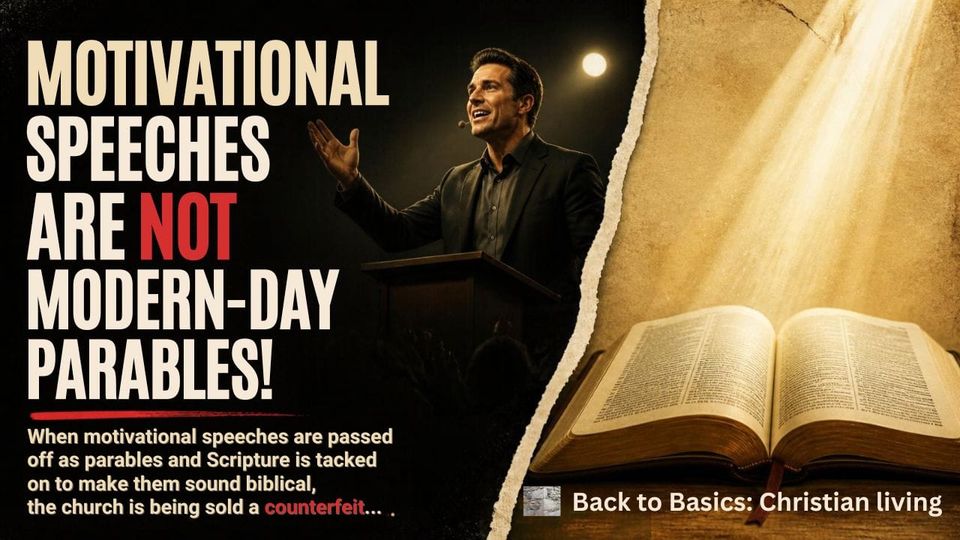
Motivational Speeches Are Not Modern-Day Parables!
Motivational Speeches Dressed Up as Parables
Modern-day motivational speeches are now being sold in the church as modern-day parables. A stirring story is told about a marathon runner, a business that came back from the brink, or a lad from nowhere who made it big, then a verse is tacked on the end and the whole thing is called a parable. The fact that those words are being used, with Scripture added to make them sound biblical, is laughable — and it is dangerously wrong. A motivational speech with a Bible reference stapled to it is still a motivational speech. Calling it a parable doesn't make it one, any more than painting a stone gold turns it into gold. And the people sitting in the seats deserve better, because they came to hear what God has said, not what a man has dreamed up to lift their mood. God put it plainly through Jeremiah: The prophet that hath a dream, let him tell a dream; and he that hath my word, let him speak my word faithfully. What is the chaff to the wheat? saith the LORD [Jeremiah 23:28 KJV]. Chaff and wheat can look alike from a distance, but only one of them will feed you.
What a Parable Really Is
So what is a parable? It isn't simply a nice story with a moral at the end. When Jesus Christ spoke in parables, every one of them carried the Word of God and the truth of the kingdom of God. He told the parable of the sower, and then He explained it Himself: Now the parable is this: The seed is the word of God [Luke 8:11 KJV]. That's the heart of it. The seed is the Word — not your potential, not your dream, not your next big breakthrough. Mark tells us how Jesus Christ used them: And with many such parables spake he the word unto them, as they were able to hear it [Mark 4:33 KJV]. He spake the word. The story was only ever the vessel; the Word was the cargo. And notice what came next: But without a parable spake he not unto them: and when they were alone, he expounded all things to his disciples [Mark 4:34 KJV]. The parables were opened up and explained, so that those who wanted the truth went away knowing it.
They also divided the hearers. When the disciples asked Him why He spoke this way, He answered, Therefore speak I to them in parables: because they seeing see not; and hearing they hear not, neither do they understand [Matthew 13:13 KJV]. A true parable searches the heart and sorts the hungry from the merely curious. It leaves you with Who hath ears to hear, let him hear [Matthew 13:9 KJV] — in other words, now you have to do something with it.
Why the Counterfeit Is So Dangerous
Now set that beside the modern motivational speech. Where does it point? Nearly always to you — your goals, your confidence, your destiny, your times. The story comes first, the feeling comes next, and somewhere near the end a verse is pulled out of its place to give the whole thing a biblical sound. David and Goliath becomes "What's the giant in your life?" The feeding of the five thousand becomes a lesson in thinking big. The Word isn't the seed any more; it's the garnish. Paul warned us about exactly this: Beware lest any man spoil you through philosophy and vain deceit, after the tradition of men, after the rudiments of the world, and not after Christ [Colossians 2:8 KJV]. That's what so much of it is — the world's self-help philosophy given a church accent. He also warned that the time would come when people shall turn away their ears from the truth, and shall be turned unto fables [2 Timothy 4:4 KJV]. A fable is a made-up story, and many of the illustrations told from pulpits today never happened at all, yet they're passed off as though they carried the same weight as the words of Jesus Christ. That isn't harmless. Add thou not unto his words, lest he reprove thee, and thou be found a liar [Proverbs 30:6 KJV]. When a man's story is put on the same shelf as the Lord's parables, the Word is being added to, and the hearer is being robbed.
Think about what it does to the people listening. A motivational speech can make you feel good for an afternoon, but it can't change your heart, because there's no power in it. The power is in the Word: For the word of God is quick, and powerful, and sharper than any twoedged sword [Hebrews 4:12 KJV]. Take the Word out of the middle and you're left with a speech that stirs the emotions and leaves the life exactly as it was. Paul refused to preach that way: And my speech and my preaching was not with enticing words of man's wisdom, but in demonstration of the Spirit and of power: That your faith should not stand in the wisdom of men, but in the power of God [1 Corinthians 2:4-5 KJV]. Faith built on a good story collapses the moment the story wears off. Faith built on the Word stands.
Hungry for the Real Thing
So how do you tell the difference when you're sitting in the seat? Ask a few plain questions. Where did the message point me — to Jesus Christ and what God has said, or to myself and what I can achieve? Was the Scripture the seed of the message, or was it tacked on at the end? Was the passage read in its place and rightly divided, or lifted out to fit the story? And did it ask anything of me — repentance, obedience, a change in how I walk — or did it simply make me feel better? Paul could say, For we are not as many, which corrupt the word of God: but as of sincerity, but as of God, in the sight of God speak we in Christ [2 Corinthians 2:17 KJV]. That's the standard. Not entertainment, not motivation, but the Word spoken plainly and sincerely, as in the sight of God.
There's nothing wrong with an illustration that helps the truth land. Jesus Christ used ordinary things — seed and soil, salt and lamps, sheep and shepherds. But the illustration must serve the Word, never replace it. We're called to walk worthy of the Lord unto all pleasing, being fruitful in every good work, and increasing in the knowledge of God [Colossians 1:10 KJV], and you'll never increase in the knowledge of God on a diet of motivational speeches. Don't be impressed by a stirring speech. Be hungry for the Word. And when you've heard it, do it: But be ye doers of the word, and not hearers only, deceiving your own selves [James 1:22 KJV].
Key Takeaways:
- A motivational speech with a verse attached is still a motivational speech, not a parable — [Jeremiah 23:28 KJV]
- In every true parable, the seed is the Word of God — [Luke 8:11 KJV]
- Jesus Christ used parables to speak the Word and then expounded them — [Mark 4:33-34 KJV]
- A true parable searches the heart and calls for a response — [Matthew 13:9 KJV]
- Self-help philosophy with a church accent is still the world's thinking — [Colossians 2:8 KJV]
- Never put a man's story on the same shelf as God's Word — [Proverbs 30:6 KJV]
- Faith must stand in the power of God, not the wisdom of men — [1 Corinthians 2:4-5 KJV]
- Be hungry for the Word, then do it — [James 1:22 KJV]
Where to go from here:
Read Matthew 13:1-23 slowly this week, and watch how Jesus Christ tells the parable of the sower and then explains it, so that the Word is never lost in the story. Then take the step above: ask of every message you hear whether the Word was the seed or only the garnish.
📽️ Watch this teaching 👉 https://www.youtube.com/watch?v=qlrL3PRJcmU&list=PLhtPbQ4aPQH5L9BycdIkD1Cmh288M1oaK&index=1
🧭 Start Here — Who We Are in Christ! — the teachings to read first 👉 https://back-to-basics-christian-living.ghost.io/start-here/
🎥 The playlist to watch alongside them 👉 https://www.youtube.com/playlist?list=PLEPKdqB9RuLI
➡️ Next in this week's theme — Wednesday: A Test for the Modern Day Prophetic Movement
That is where we begin: who we are in Christ, taken in order. Then, Monday to Thursday, we take one truth and look at it from four sides — this week, false teaching in the modern church, and how to test it by the Book. Fridays, we work through a series — at present Ephesians: The Letter Written to You. One email on Sunday closes the week and opens the next.
🙏 Write and tell us what God has done 👉 backtobasicschristianliving@gmail.com, and let us know if we're free to share it in The Christian Compass on Sundays, to encourage someone else. And if this helped you, send it to one person who needs it this week.
Back to Basics: Christian living — plain, practical, powerful Bible teaching you can live out today.
🔗 Everything in one place 👉 https://linktr.ee/backtobasicschristianliving