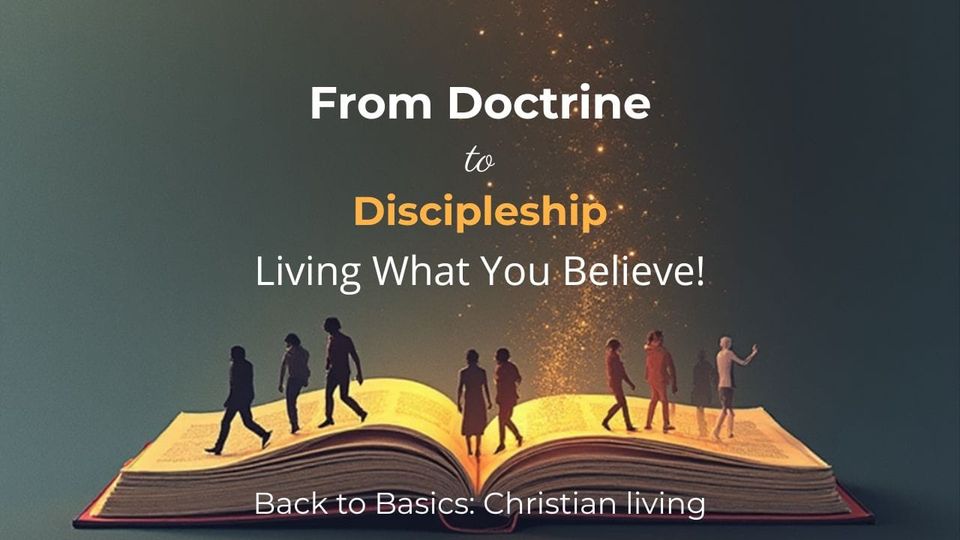
From Doctrine to Discipleship: Living What You Believe!
The Crisis of Knowledge Without Action
The Church today faces a critical crisis: we've become experts in theology but failures in application. We can quote Scripture, debate doctrine, and fill notebooks with sermon notes—but when Monday morning comes, our lives look no different from the world around us. This disconnect between what we know and how we live isn't just disappointing; it's dangerous.
The apostle James confronted this very issue in the early Church when he wrote, "But be ye doers of the word, and not hearers only, deceiving your own selves" (James 1:22 KJV). Notice the word "deceiving"—self-deception is the fruit of knowledge without practice. We convince ourselves that because we understand a truth, we've somehow mastered it. But understanding and obedience are worlds apart.
Jesus Himself warned about this disconnect. In the Sermon on the Mount, He said, "Not every one that saith unto me, Lord, Lord, shall enter into the kingdom of heaven; but he that doeth the will of my Father which is in heaven" (Matthew 7:21 KJV). The repetition of "Lord, Lord" suggests these are people who appear religious, who use the right vocabulary, who perhaps even perform religious activities. Yet they're rejected because profession without practice is worthless.
The Problem Isn't Lack of Information
The problem isn't that we lack information. We have more Bible translations, commentaries, podcasts, and teaching resources than any generation in history. The problem is that we've mistaken accumulating knowledge for spiritual growth. We've created a Christianity of the mind that never reaches the hands and feet.
True doctrine always—and I mean always—produces true discipleship. You cannot genuinely believe something without it affecting how you live. If your theology hasn't changed your behaviour, you don't really believe it; you've merely intellectually agreed with it. There's a vast difference.
Paul understood this principle. Writing to Titus, he said, "In all things shewing thyself a pattern of good works: in doctrine shewing uncorruptness, gravity, sincerity" (Titus 2:7 KJV). Notice the connection—doctrine and good works aren't separate categories. Sound doctrine naturally produces good works. The pattern of your life should reflect the purity of your teaching.
The Early Church Example
Consider the early Church in Acts. When they believed in the resurrection, they didn't just add it to their creed; they lived with radical generosity because death no longer had the final word. When they understood grace, they extended it to outcasts and sinners. When they grasped the truth of the Holy Spirit, they operated in supernatural power. Belief and practice were inseparable.
Luke records, "And they continued stedfastly in the apostles' doctrine and fellowship, and in breaking of bread, and in prayers" (Acts 2:42 KJV). The apostles' doctrine wasn't a Sunday lecture series—it was a lived reality that shaped their community, their worship, and their prayer life. Doctrine created culture, and culture reinforced practice.
Scholars or Disciples?
The tragedy of modern Christianity is that we've severed this connection. We sit through sermons, attend Bible studies, and collect theological degrees, but our marriages still fail, our finances remain chaotic, our relationships are shallow, and our witness is powerless. Why? Because we're scholars, not disciples.
A disciple isn't someone who knows about Jesus; a disciple is someone who follows Jesus. The Greek word for disciple, mathētēs, means "learner" or "student," but it carries the idea of apprenticeship—learning by doing, not just listening. Jesus didn't gather students to fill their heads; He called disciples to transform their lives.
When Jesus called Peter and Andrew, He said, "Follow me, and I will make you fishers of men" (Matthew 4:19 KJV). The call was to action—follow, and I will make you. Transformation happens in the following, not in the seminar room. They didn't become fishers of men by studying a curriculum; they became fishers of men by walking with Jesus, watching Him, and doing what He did.
Love Demonstrated Through Obedience
This should trouble us deeply. We've created a system where people can claim to be Christians while living in complete contradiction to Scripture. We've made discipleship optional, something for the "super committed" rather than the basic expectation for every believer. But Jesus never offered that option.
He said, "If ye love me, keep my commandments" (John 14:15 KJV). Not "study my commandments," not "appreciate my commandments," not "discuss my commandments"—keep them. Love is demonstrated through obedience, not intellectual agreement.
The writer of Hebrews rebuked his audience for this same problem: "For when for the time ye ought to be teachers, ye have need that one teach you again which be the first principles of the oracles of God; and are become such as have need of milk, and not of strong meat" (Hebrews 5:12 KJV). They'd been Christians long enough to teach others, but they remained spiritual infants because knowledge without application produces no growth.
The Solution: Inseparable Doctrine & Practice
So what's the solution? We must return to the biblical model where doctrine and practice are inseparable. Every truth we learn should come with the question: "How does this change how I live today?" Every sermon should end not with "wasn't that interesting?" but with "what will I do differently this week?"
James gives us the image: "For if any be a hearer of the word, and not a doer, he is like unto a man beholding his natural face in a glass: For he beholdeth himself, and goeth his way, and straightway forgetteth what manner of man he was" (James 1:23-24 KJV). The Word is meant to be a mirror that reveals who we are so we can make changes. But if we look and walk away unchanged, we've missed the entire point.
What the Church Really Needs
The Church doesn't need more conferences, more books, or more programmes. We need Christians who will take the doctrine they claim to believe and put it into practice. We need fewer scholars and more disciples—people whose lives are living proof that the Gospel is true, that God is real, and that His Word transforms everything it touches.
Paul's exhortation to Timothy applies to us all: "Take heed unto thyself, and unto the doctrine; continue in them: for in doing this thou shalt both save thyself, and them that hear thee" (1 Timothy 4:16 KJV). Notice the balance—take heed to yourself (your practice) and to the doctrine (your beliefs). Both matter. Continue in both. Salvation and witness depend on it.
It's time for the Church to stop playing at Christianity and start living it. Take your doctrine and put it into practice. Let your theology shape your Monday as much as your Sunday. Become a doer, not just a hearer. Because true doctrine always produces true discipleship—always…
Key Takeaways:
- Knowledge without action is self-deception – Understanding biblical truth means nothing if it doesn't transform how we live daily (James 1:22 KJV)
- True doctrine always produces true discipleship – Genuine belief in biblical truth inevitably changes behaviour; if your theology hasn't changed your life, you don't truly believe it
- The problem isn't lack of information – We have more resources than ever, yet we've mistaken accumulating knowledge for spiritual growth
- Disciples follow, not just study – Jesus called people to apprenticeship (learning by doing), not academic study. Transformation happens in the following
- Love is demonstrated through obedience – Jesus said, "If ye love me, keep my commandments" (John 14:15 KJV). Obedience, not intellectual agreement, proves love
- Every truth requires application – Ask with every biblical truth: "How does this change how I live today?" The Word is a mirror meant to produce change (James 1:23-24 KJV)
- Balance doctrine and practice – Paul told Timothy to "take heed unto thyself, and unto the doctrine" (1 Timothy 4:16 KJV). Both your beliefs and your behaviour matter equally
- The Church needs doers, not just hearers – We need fewer scholars and more disciples whose lives are living proof that the Gospel transforms everything it touches