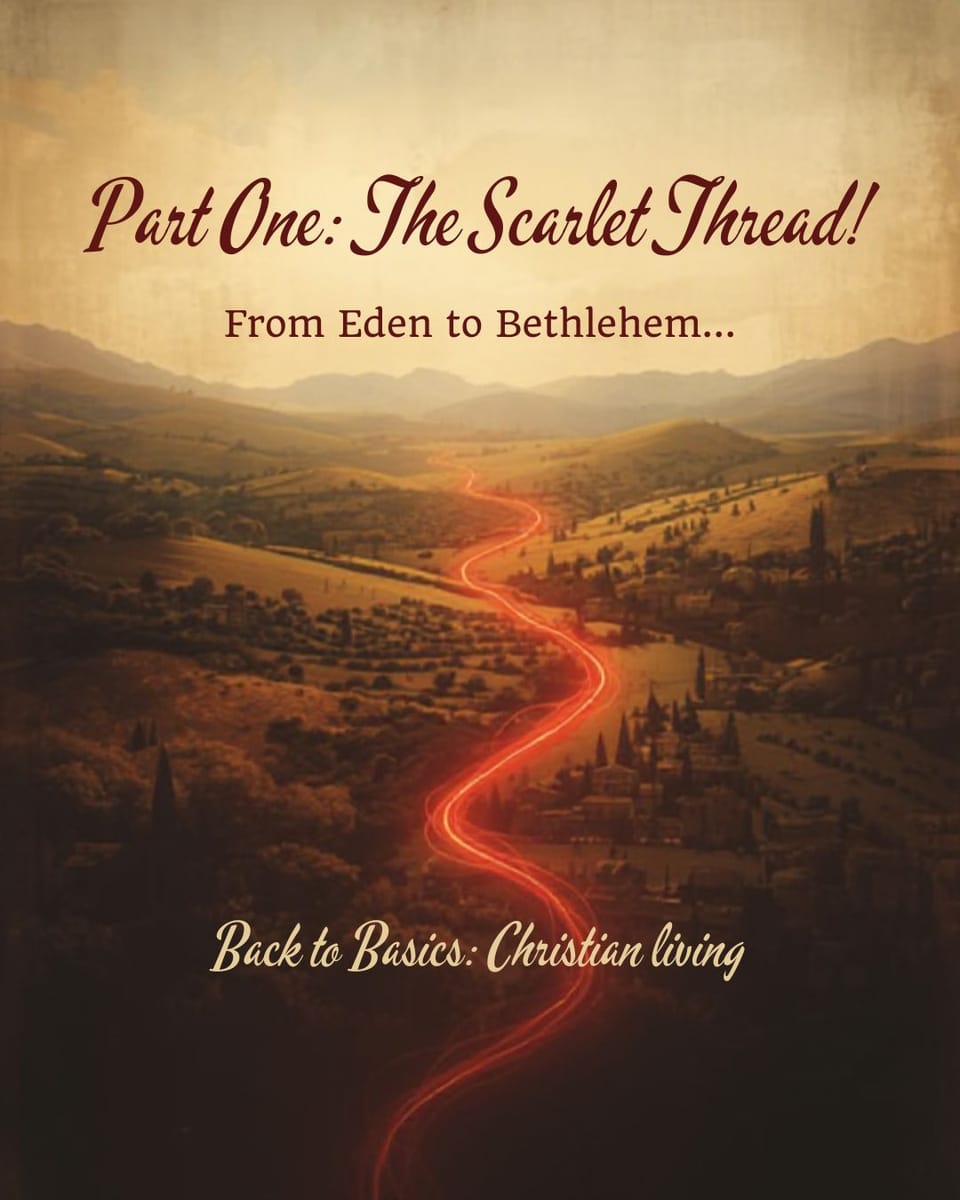
Part One: The Scarlet Thread!
The Promise Unfolds
From the moment sin entered the world in the Garden of Eden, God began weaving a scarlet thread of redemption through history—a thread that would culminate in the birth of Jesus Christ in Bethlehem. This divine tapestry reveals God's unchanging love and His eternal plan to reconcile humanity to Himself.
The Promise in the Garden
When Adam and Eve sinned, bringing death and separation into creation, God immediately spoke a promise that would echo through the ages. To the serpent, He declared: "And I will put enmity between thee and the woman, and between thy seed and her seed; it shall bruise thy head, and thou shalt bruise his heel" (Genesis 3:15, KJV). This first gospel proclamation pointed to a coming Redeemer who would crush Satan's power, though at great cost to Himself.
God then clothed Adam and Eve with garments of skin (Genesis 3:21, KJV), requiring the death of an innocent animal—the first blood sacrifice foreshadowing Christ's ultimate sacrifice. Sin demanded death, but God provided a substitute, establishing a pattern that would run throughout Scripture.
The Scarlet Thread Through the Patriarchs
The thread continued through Noah, to whom God promised never again to destroy the earth by flood (Genesis 9:11, KJV), demonstrating His covenant faithfulness. Through Abraham, God revealed more of His redemptive plan: "And in thy seed shall all the nations of the earth be blessed" (Genesis 22:18, KJV). When Abraham raised the knife to sacrifice Isaac, God provided a ram caught in a thicket (Genesis 22:13, KJV)—another powerful picture of substitutionary sacrifice pointing to Christ, the Lamb of God.
Jacob, wrestling with God, received both a blessing and a new name, Israel (Genesis 32:28, KJV). Through his son Judah would come the promised Messiah, as Jacob prophesied: "The sceptre shall not depart from Judah, nor a lawgiver from between his feet, until Shiloh come" (Genesis 49:10, KJV). This "Shiloh"—meaning "peace-bringer"—would be Jesus Christ.
The Passover & the Law
The scarlet thread became vivid in Egypt when God commanded each household to sacrifice a lamb and apply its blood to their doorposts: "And when I see the blood, I will pass over you" (Exodus 12:13, KJV). This Passover lamb pointed directly to Christ, "our Passover sacrificed for us" (1 Corinthians 5:7, KJV).
Through Moses, God established the sacrificial system detailed in Leviticus. The Day of Atonement required the high priest to enter the Holy of Holies with blood to make atonement for the people's sins (Leviticus 16:15-16, KJV). These repeated sacrifices could never truly remove sin—they merely covered it temporarily, pointing forward to the perfect sacrifice to come. "For it is not possible that the blood of bulls and of goats should take away sins" (Hebrews 10:4, KJV).
The Prophetic Thread
The prophets wove the scarlet thread through their writings with increasing clarity. Isaiah painted perhaps the most vivid portrait of the suffering Messiah: "He is despised and rejected of men; a man of sorrows, and acquainted with grief" (Isaiah 53:3, KJV). He described how "the LORD hath laid on him the iniquity of us all" (Isaiah 53:6, KJV), and how He would be "brought as a lamb to the slaughter" (Isaiah 53:7, KJV).
Micah prophesied the exact location of Messiah's birth: "But thou, Bethlehem Ephratah, though thou be little among the thousands of Judah, yet out of thee shall he come forth unto me that is to be ruler in Israel" (Micah 5:2, KJV). This seemingly insignificant village would become the birthplace of the King of Kings.
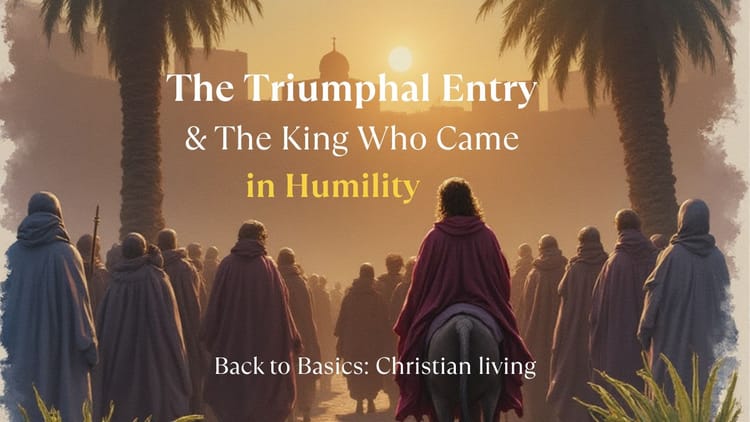
Daniel revealed the timing, speaking of "Messiah the Prince" (Daniel 9:25, KJV), whilst Zechariah prophesied His triumphal entry: "Behold, thy King cometh unto thee...lowly, and riding upon an ass" (Zechariah 9:9, KJV), and His betrayal for thirty pieces of silver (Zechariah 11:12-13, KJV).
The Thread Reaches Bethlehem
After four hundred years of prophetic silence, the scarlet thread reached its pivotal moment. The angel Gabriel appeared to a virgin named Mary in Nazareth, announcing: "Behold, thou shalt conceive in thy womb, and bring forth a son, and shalt call his name JESUS. He shall be great, and shall be called the Son of the Highest" (Luke 1:31-32, KJV).
When Caesar Augustus decreed a census, God's sovereign hand moved Joseph and Mary to Bethlehem, fulfilling Micah's ancient prophecy. There, in a humble stable, "she brought forth her firstborn son, and wrapped him in swaddling clothes, and laid him in a manger" (Luke 2:7, KJV). The eternal Word became flesh and dwelt amongst us (John 1:14, KJV).
Angels proclaimed to shepherds: "For unto you is born this day in the city of David a Saviour, which is Christ the Lord" (Luke 2:11, KJV). The promised seed of the woman, the seed of Abraham, the Lion of Judah, the Prophet like Moses, the suffering Servant, the Son of David—all converged in this infant King…
Key Takeaways:
- God's redemptive plan was established from the beginning: From the moment sin entered the world in Eden, God promised a Redeemer who would crush Satan's power (Genesis 3:15 KJV ).
- Blood sacrifice points to Christ: Every sacrifice throughout Scripture—from the animal skins in Eden to the Passover lamb to the Day of Atonement—foreshadowed Christ's ultimate sacrifice on the cross.
- The scarlet thread runs through all of Scripture: God's promise of redemption was woven consistently through the patriarchs, the Law, and the prophets, all pointing towards the coming Messiah.
- Prophecy reveals God's sovereign plan: Specific prophecies about the Messiah's lineage (through Judah), birthplace (Bethlehem), character (suffering Servant), and mission (Saviour) were fulfilled in Jesus Christ.
- Jesus is the fulfilment of all God's promises: In Bethlehem, the eternal Word became flesh—the promised seed, the Lion of Judah, the Prophet, the suffering Servant, and the Son of David all converged in one infant King.
- Substitutionary sacrifice is central to redemption: From the ram in place of Isaac to the Passover lamb, God consistently demonstrated that sin requires death, but He Himself provides the substitute—ultimately His own Son.