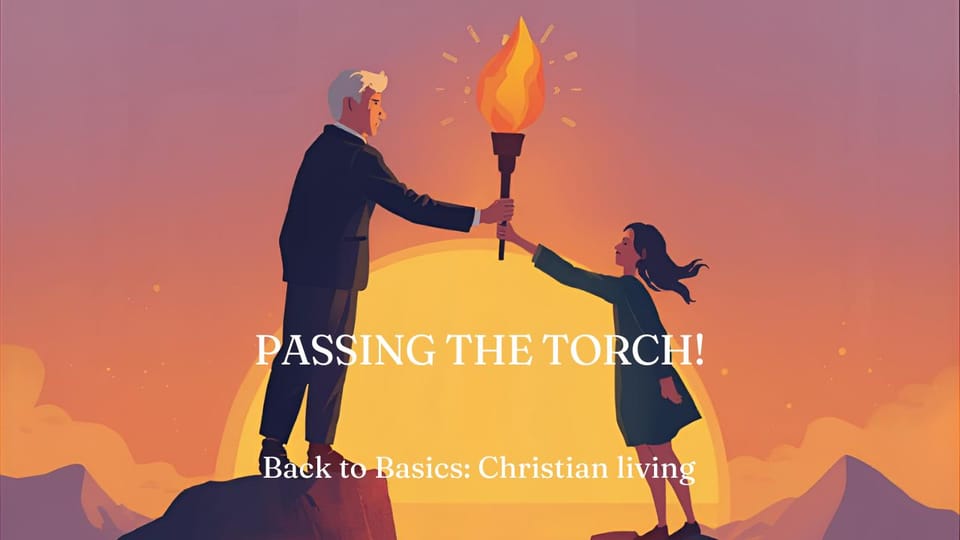
Passing the Torch!
The Call to Faithful Stewardship
In the heart of the New Testament, nestled within Paul's second letter to his spiritual son Timothy, lies a verse that encapsulates the very essence of Christian discipleship and spiritual multiplication. "And the things that thou hast heard of me among many witnesses, the same commit thou to faithful men, who shall be able to teach others also" (2 Timothy 2:2, KJV). This profound instruction reveals God's master plan for perpetuating the Gospel and building His kingdom—not through elaborate programmes or impressive institutions alone, but through the faithful transmission of truth from one generation to the next.
The Context of Paul's Charge
When Paul penned these words, he was facing imminent martyrdom in a Roman prison. Knowing his earthly ministry was drawing to a close, he wrote with urgency to Timothy, his beloved disciple and co-labourer in the Gospel. The apostle wasn't merely offering good advice; he was issuing a sacred charge that would ensure the survival and spread of Christianity beyond his own lifetime.
Paul understood what Jesus had demonstrated throughout His earthly ministry: that authentic discipleship involves intentional investment in others. Jesus spent three years pouring His life into twelve men, who would then turn the world upside down with the Gospel message. This same principle now passed from Paul to Timothy, with the expectation that it would continue through countless generations.
Four Generations of Faithfulness
A remarkable aspect of 2 Timothy 2:2 (KJV) is that it contains four distinct generations within a single verse. First, there is Paul himself—the teacher and apostle. Second, Timothy—the one who heard from Paul "among many witnesses." Third, the "faithful men" to whom Timothy must commit these truths. Fourth, "others also" who will be taught by those faithful men. This exponential model of discipleship ensures that the Gospel doesn't simply survive but thrives and multiplies.
This principle echoes throughout Scripture. In Deuteronomy 6:6-7 (KJV). Moses instructed the Israelites: "And these words, which I command thee this day, shall be in thine heart: And thou shalt teach them diligently unto thy children, and shalt talk of them when thou sittest in thine house, and when thou walkest by the way, and when thou liest down, and when thou risest up". The pattern is clear—God's truth must be passed down faithfully from generation to generation.
The Qualities Required: Faithfulness Above All
Notice that Paul doesn't instruct Timothy to commit these truths to the most talented, the most charismatic, or the most educated. Rather, he emphasises faithfulness. "Commit thou to faithful men" (2 Timothy 2:2, KJV). This word "faithful" (Greek: pistos) speaks of those who are trustworthy, reliable, and steadfast in their commitment to the truth.
Scripture consistently elevates faithfulness as a supreme virtue. Jesus taught in the parable of the talents, "Well done, thou good and faithful servant: thou hast been faithful over a few things, I will make thee ruler over many things" (Matthew 25:21, KJV). In 1 Corinthians 4:2 (KJV). Paul writes, "Moreover it is required in stewards, that a man be found faithful". God doesn't call us to be successful by worldly standards; He calls us to be faithful with what He has entrusted to us.
The Content: "The Things That Thou Hast Heard"
What exactly should be committed to faithful men? Paul refers to "the things that thou hast heard of me among many witnesses" (2 Timothy 2:2, KJV). This phrase encompasses the apostolic teaching—the doctrines, instructions, and truths about Jesus Christ that Paul had faithfully proclaimed throughout his ministry.
These truths include the Gospel message itself: "For I delivered unto you first of all that which I also received, how that Christ died for our sins according to the scriptures; And that he was buried, and that he rose again the third day according to the scriptures" (1 Corinthians 15:3-4, KJV). They include sound doctrine: "All scripture is given by inspiration of God, and is profitable for doctrine, for reproof, for correction, for instruction in righteousness" (2 Timothy 3:16, KJV). They include practical godliness and holy living that adorns the Gospel.
Paul had earlier urged Timothy, "Hold fast the form of sound words, which thou hast heard of me, in faith and love which is in Christ Jesus. That good thing which was committed unto thee keep by the Holy Ghost which dwelleth in us" (2 Timothy 1:13-14, KJV). The content we pass on must be the unchanging truth of God's Word, not the shifting philosophies of human wisdom.
The Method: Intentional Investment
The word "commit" (Greek: paratithemi) in 2 Timothy 2:2 (KJV) means to deposit, entrust, or place alongside. It suggests a deliberate, intentional act—not casual or haphazard transmission. This requires time, relationship, and personal investment.
Jesus modelled this approach perfectly. Mark records that He "ordained twelve, that they should be with him, and that he might send them forth to preach" (Mark 3:14, KJV). Notice the order: first "with him," then "send them forth." Discipleship begins with relationship and proximity. Jesus didn't merely preach to the masses; He invested deeply in a few who would carry on His mission.
Paul likewise invested personally in Timothy, Titus, Silas, and others. He could write to the Thessalonians, "So being affectionately desirous of you, we were willing to have imparted unto you, not the gospel of God only, but also our own souls, because ye were dear unto us" (1 Thessalonians 2:8, KJV). True discipleship involves giving not just information but our very lives.
The Goal: Multiplication, Not Just Addition
The ultimate aim of 2 Timothy 2:2 (KJV) is multiplication—that those who are taught "shall be able to teach others also." This phrase reveals God's vision for exponential kingdom growth. If every believer faithfully discipled just a few others, who in turn discipled a few more, the impact would be staggering.
This principle appears throughout the New Testament. In Acts 6:7 (KJV), we read, "And the word of God increased; and the number of the disciples multiplied in Jerusalem greatly" . Jesus commissioned His disciples, "Go ye therefore, and teach all nations, baptizing them in the name of the Father, and of the Son, and of the Holy Ghost: Teaching them to observe all things whatsoever I have commanded you" (Matthew 28:19-20, KJV). The Great Commission is essentially a call to reproduce disciples who reproduce disciples.
The Challenge for Today's Church
In our contemporary context, we must ask ourselves: are we faithfully living out 2 Timothy 2:2 (KJV)? Are we intentionally investing in others who will invest in others still? Or have we become consumers of religious services rather than reproducers of disciples?
The church doesn't exist merely to gather on Sundays but to equip believers "for the work of the ministry, for the edifying of the body of Christ" (Ephesians 4:12, KJV). Every Christian is called to this ministry of passing on what they have received. As Peter writes, "As every man hath received the gift, even so minister the same one to another, as good stewards of the manifold grace of God" (1 Peter 4:10, KJV).
Practical Steps Forward
How can we apply 2 Timothy 2:2 (KJV). in our lives?
First, we must ensure we are being discipled ourselves—sitting under sound teaching, growing in our knowledge of God's Word, and maturing in Christlikeness. We cannot give what we have not received.
Second, we must prayerfully identify those "faithful men" (and women) in whom we can invest. Who has God placed in our sphere of influence? Who demonstrates a teachable spirit and genuine hunger for God?
Third, we must commit to the process, understanding that discipleship takes time and intentionality. It may involve regular meetings, shared experiences, accountability, and prayer. It certainly requires vulnerability and authenticity.
Finally, we must release those we disciple to disciple others, trusting that God will multiply our faithfulness far beyond what we can see or imagine.
A Legacy That Outlives Us
Paul's charge to Timothy in 2 Timothy 2:2 (KJV) offers us a vision that transcends our brief time on earth. When we faithfully pass on the truth to others who pass it on to others still, we create a legacy that outlives us and impacts eternity. We become part of an unbroken chain stretching from the apostles to the present day and extending into the future until Christ returns.
May we hear afresh this sacred charge and commit ourselves to the glorious work of making disciples who make disciples. As Paul wrote in his final words to Timothy, "I have fought a good fight, I have finished my course, I have kept the faith: Henceforth there is laid up for me a crown of righteousness" (2 Timothy 4:7-8, KJV). May the same be said of us when our earthly course is complete…
Key Takeaways:
- 📖 2 Timothy 2:2 (KJV) reveals a four-generation discipleship model – Paul to Timothy to faithful men to others – ensuring exponential Gospel multiplication
- 💎 Faithfulness is the primary qualification – God seeks trustworthy, reliable disciples over talented or charismatic ones
- 📜 The content must be apostolic truth – the unchanging Gospel message, sound doctrine, and practical godliness from Scripture
- 🤝 Discipleship requires intentional investment – deliberate commitment of time, relationship, and personal involvement, not casual transmission
- ✖️ The goal is multiplication, not addition – every believer discipling others who disciple others creates exponential kingdom growth
- 🎯 Every Christian is called to this ministry – we must ensure we're being discipled, identify faithful people to invest in, commit to the process, and release them to disciple others
- 👑 This creates an eternal legacy – faithfully passing on truth creates an impact that outlives us and extends until Christ returns