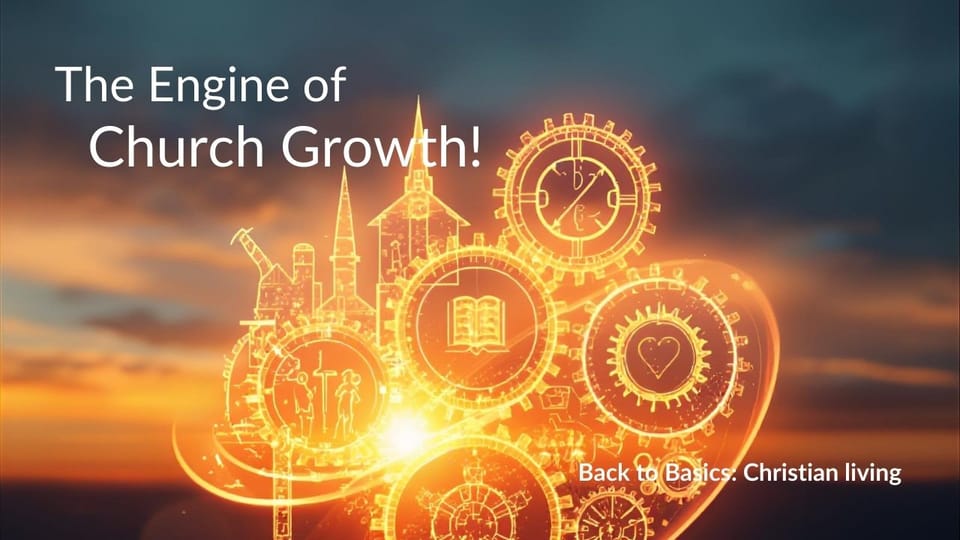
The Engine of Church Growth!
The Multiplication Principle in Action
Discipleship carries the mandate to multiply. The apostle Paul understood this principle when he instructed Timothy: "And the things that thou hast heard of me among many witnesses, the same commit thou to faithful men, who shall be able to teach others also" [2 Timothy 2:2 KJV]. We see here a beautiful pattern of multiplication—Paul discipled Timothy, Timothy was to disciple faithful men, and they in turn would teach others. This is the engine of church growth and kingdom expansion that Christ intended when He gave the Great Commission.
The Foundation of the Great Commission
When Jesus gave His final instructions to the disciples, He didn't simply tell them to gather crowds or build impressive institutions. Instead, He commanded: "Go ye therefore, and teach all nations, baptizing them in the name of the Father, and of the Son, and of the Holy Ghost: Teaching them to observe all things whatsoever I have commanded you" [Matthew 28:19-20 KJV]. The emphasis here is unmistakable—making disciples who would observe and obey all that Christ taught. This wasn't merely about conversion; it was about transformation and reproduction.
The DNA of Spiritual Reproduction
From the very beginning of His earthly ministry, Jesus modelled this principle of multiplication. He didn't try to reach the masses alone. Instead, "He ordained twelve, that they should be with him, and that he might send them forth to preach" [Mark 3:14 KJV]. Jesus invested deeply in a small group, knowing that through them, His message would eventually reach the entire world. This wasn't inefficiency—it was divine wisdom.
The principle is woven throughout Scripture. Moses was instructed by his father-in-law Jethro to raise up leaders who could teach and guide the people: "And thou shalt teach them ordinances and laws, and shalt shew them the way wherein they must walk, and the work that they must do" [Exodus 18:20 KJV]. This wasn't just delegation; it was multiplication.
The Four Generations of Discipleship
Paul's instruction to Timothy reveals a four-generation discipleship chain: Paul to Timothy, Timothy to faithful men, faithful men to others. This exponential growth is the engine that powered the early church's expansion. Consider the mathematics: if one person disciples two others in a year, and each of those disciples two more the following year, within just a few generations, thousands could be reached. But if that same person simply adds one convert per year through their own efforts alone, the growth remains linear and limited.
The early church understood this. We read in Acts that "the word of God increased; and the number of the disciples multiplied in Jerusalem greatly" [Acts 6:7 KJV]. Notice it doesn't say the word merely "spread" or that disciples were "added"—they multiplied. This is the language of reproduction, not just accumulation.
The Characteristics of Multiplying Disciples
Paul's instruction to Timothy identifies a crucial quality: "faithful men" [2 Timothy 2:2 KJV]. Not the most talented, not the most charismatic, but the faithful. Faithfulness is the key to multiplication because faithful disciples will remain steadfast in teaching others, who will in turn teach others still. A chain is only as strong as its weakest link, and in discipleship multiplication, faithfulness ensures the chain doesn't break.
These faithful disciples must also be "able to teach others" [2 Timothy 2:2 KJV]. It's not enough to simply know truth—we must be equipped to pass it on. This requires intentionality, training, and investment. Paul demonstrated this by staying in Ephesus for two years, "so that all they which dwelt in Asia heard the word of the Lord Jesus" [Acts 19:10 KJV]—not because Paul personally preached to everyone in Asia, but because he trained disciples who went throughout the region.
When the Engine is Broken
Is the engine in your church broken?
Many churches today have abandoned the multiplication model for an addition model. They focus on attracting crowds to hear one gifted speaker rather than equipping every believer to make disciples. The result is impressive attendance figures but minimal transformation and reproduction. Jesus warned against this superficiality: "Many will say to me in that day, Lord, Lord, have we not prophesied in thy name? and in thy name have cast out devils? and in thy name done many wonderful works? And then will I profess unto them, I never knew you" [Matthew 7:22-23 KJV].
A broken engine produces consumers rather than disciples, spectators rather than participators. When discipleship is reduced to attending services and programmes, the multiplication stops. Paul reminded the Corinthians: "For though ye have ten thousand instructors in Christ, yet have ye not many fathers" [1 Corinthians 4:15 KJV]. There's a difference between teaching information and investing in transformation.
Repairing the Engine
How do we repair this broken engine?
First, we must return to Jesus' model of intensive investment in a few. He didn't disciple the five thousand—He discipled the twelve, and even more intensively, the three.
Second, we must shift from measuring success by attendance to measuring it by multiplication. Are we producing disciples who can disciple others?
Third, we must embrace Paul's instruction: "And the things that thou hast heard of me among many witnesses, the same commit thou to faithful men, who shall be able to teach others also" [2 Timothy 2:2 KJV]. This requires intentionality. We must identify faithful men and women, invest in them deeply, equip them to teach, and then release them to repeat the process.
The Promise of Multiplication
When the engine is working properly, remarkable things happen. The book of Acts records that even through persecution, "they that were scattered abroad went every where preaching the word" [Acts 8:4 KJV]. The church wasn't stopped because every believer was equipped to make disciples.
Jesus promised: "Verily, verily, I say unto you, He that believeth on me, the works that I do shall he do also; and greater works than these shall he do; because I go unto my Father" [John 14:12 KJV]. This promise is fulfilled not through individual super-Christians, but through the multiplication of faithful disciples throughout the world.
The engine of church growth is not programmes, buildings, or even powerful preaching—it's multiplying disciples who make disciples. When we embrace this biblical pattern, we unleash exponential kingdom expansion. The question for every believer and every church is simple: Is your engine running?
Key Takeaways:
- Multiplication, not addition: True church growth comes through disciples making disciples, not just gathering crowds (2 Timothy 2:2 KJV)
- Four generations of impact: Paul → Timothy → faithful men → others—this exponential pattern is the biblical model for kingdom expansion
- The Great Commission prioritizes transformation: Jesus commanded us to make disciples who observe and obey all He taught, not just converts (Matthew 28:19-20 KJV)
- Jesus invested deeply in a few: He discipled twelve (and especially three), knowing this would multiply across the world—it's divine wisdom, not inefficiency
- Faithfulness over talent: Look for faithful people who are teachable and able to teach others—faithfulness ensures the discipleship chain doesn't break
- Many churches have a broken engine: Focusing on one gifted speaker and impressive programmes creates consumers, not multiplying disciples
- Repair the engine with intentionality: Return to Jesus' model—invest intensively in a few, measure success by multiplication, identify and equip faithful disciples
- Every believer can and should disciple others: The early church spread rapidly because every believer was equipped to make disciples, even through persecution (Acts 8:4 KJV)