The Self Centred Nature of Modern Christians!
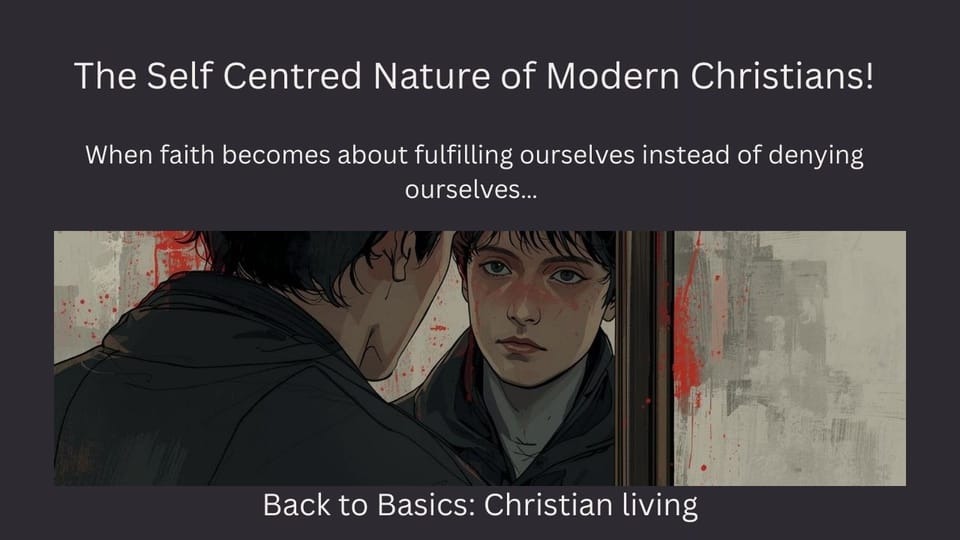
A Faith That Looks Like the World
Walk into many churches today and listen carefully to the language being used. Notice the focus of the prayers, the themes of the worship songs, and the content of the sermons. What you'll often hear is a faith that sounds remarkably self-centred. "God, bless me. Help me. Make my life better. Give me purpose. Fulfil my dreams." Even though believers claim it's all about Jesus, if we're honest, the majority of the time it's really all about us.
This is not the Christianity of the New Testament. This is not the faith that turned the world upside down. Somewhere along the way, we've traded the call to deny ourselves for a gospel that promises to fulfil ourselves. It's time we return to what Scripture actually teaches about the Christian life.
Jesus' Clear Call to Self-Denial
Jesus could not have been clearer about the cost of following Him. He said, "If any man will come after me, let him deny himself, and take up his cross daily, and follow me" (Luke 9:23 KJV). Notice the order: deny yourself first, then take up your cross, then follow Him. Self-denial isn't an optional add-on for super-spiritual Christians—it's the entry point to genuine discipleship.
He went further: "For whosoever will save his life shall lose it: but whosoever will lose his life for my sake, the same shall save it" (Luke 9:24 KJV). This is the great paradox of Christianity. The way up is down. The way to truly live is to die to self. The way to find yourself is to lose yourself in Christ.
Yet modern Christianity often flips this on its head. We're told that Jesus wants to help us reach our full potential, live our best life, and achieve our dreams. But Jesus never said, "Come unto me and I'll make all your dreams come true." He said, "Come unto me, all ye that labour and are heavy laden, and I will give you rest" (Matthew 11:28 KJV)—rest from striving, rest from self-focus, rest from the exhausting work of building our own kingdoms.
The Prayer Life That Reveals Our Heart
Our prayer life often exposes the self-centred nature of our faith. James wrote, "Ye ask, and receive not, because ye ask amiss, that ye may consume it upon your lusts" (James 4:3 KJV). How much of our prayer time is spent asking God to serve our agenda rather than submitting to His? How often do we pray, "Thy kingdom come, Thy will be done" (Matthew 6:10 KJV) and actually mean it—even if His will conflicts with our comfort?
Consider the disciples. When they asked Jesus to teach them to pray, He gave them a model that begins not with our needs but with God's glory: "Our Father which art in heaven, Hallowed be thy name" (Matthew 6:9 KJV). God's name, God's kingdom, God's will—these come first. Our daily needs are mentioned, but they're secondary to the supremacy of God.
Worship: For Him or For Us?
Modern worship culture often reveals our self-centeredness. We evaluate worship services based on how they made us feel. "I didn't get anything out of that worship." "That sermon didn't speak to me." "I need a church that meets my needs." But worship, by definition, is about ascribing worth to God, not extracting feelings for ourselves.
Paul instructed, "Whether therefore ye eat, or drink, or whatsoever ye do, do all to the glory of God" (1 Corinthians 10:31 KJV). The purpose of our worship—indeed, the purpose of our entire lives—is God's glory, not our emotional satisfaction. When we leave a worship service asking, "What did I get out of that?" instead of "Did I honour God in that?", we've missed the point entirely.
The Prosperity Gospel's Subtle Poison
Perhaps nowhere is the self-centred nature of modern Christianity more evident than in the prosperity gospel. This teaching suggests that God's primary concern is our health, wealth, and happiness. But Jesus warned, "Take heed, and beware of covetousness: for a man's life consisteth not in the abundance of the things which he possesseth" (Luke 12:15 KJV).
Paul, who experienced beatings, imprisonments, shipwrecks, and constant danger, wrote that he had "learned, in whatsoever state I am, therewith to be content" (Philippians 4:11 KJV). His contentment wasn't based on circumstances but on Christ. He could say, "For to me to live is Christ, and to die is gain" (Philippians 1:21 KJV). Can we say the same? Or have we made Christ a means to an end—the end being our own prosperity and comfort?
Decreasing So He May Increase
John the Baptist understood something many modern Christians have forgotten. When his disciples worried that Jesus was gaining more followers than John, he replied, "He must increase, but I must decrease" (John 3:30 KJV). This should be the anthem of every believer's life. Less of me, more of Him. Less of my agenda, more of His will. Less of my glory, more of His renown.
This decreasing is not about low self-esteem or unhealthy self-hatred. It's about right positioning. It's recognizing that "ye are not your own" because "ye are bought with a price" (1 Corinthians 6:19-20 KJV). We belong to Christ. Our lives are His to direct, His to use, His to glorify Himself through.
The Call to True Discipleship
Jesus never promised that following Him would be easy or comfortable. He said, "In the world ye shall have tribulation" (John 16:33 KJV). He told His disciples, "If the world hate you, ye know that it hated me before it hated you" (John 15:18 KJV). This doesn't sound like the "best life now" message we often hear today.
True discipleship costs everything. Jesus said, "Whosoever he be of you that forsaketh not all that he hath, he cannot be my disciple" (Luke 14:33 KJV). All means all. Our dreams, our plans, our rights, our comfort—everything must be laid at His feet.
The question we must ask ourselves is this: Is my faith truly about Jesus, or is it subtly about me? Am I seeking to use God for my purposes, or have I surrendered to be used by God for His purposes? Am I following Christ, or am I asking Christ to follow me?
Paul wrote, "I am crucified with Christ: nevertheless I live; yet not I, but Christ liveth in me: and the life which I now live in the flesh I live by the faith of the Son of God, who loved me, and gave himself for me" (Galatians 2:20 KJV). This is the Christian life—not self-improvement but self-crucifixion. Not self-fulfilment but Christ-enthronement.
It's time to return to the basics of what it means to be a Christian. It's time to make it truly about Jesus. Not just in our words, but in our worship, our prayers, our priorities, and our daily lives. When we decrease and He increases, we discover what we were always meant to be: worshippers who live for an audience of One, bringing glory to His name alone…
Key Takeaways:
- Modern Christianity has become self-centred – Much of today's church focuses on what God can do for us rather than denying ourselves to follow Him.
- Jesus calls us to self-denial first – "If any man will come after me, let him deny himself, and take up his cross daily, and follow me" (Luke 9:23 KJV). Self-denial is the entry point to discipleship, not an optional extra.
- Our prayers reveal our hearts – When we ask God to serve our agenda rather than submit to His will, we expose our self-focus (James 4:3 KJV).
- Worship is for God's glory, not our feelings – We shouldn't evaluate worship by what we "got out of it" but by whether we honoured God (1 Corinthians 10:31 KJV).
- The prosperity gospel is poison – Teaching that God's primary concern is our health, wealth, and happiness contradicts Scripture and Paul's example of contentment in all circumstances.
- "He must increase, but I must decrease" – John the Baptist's anthem should be ours: less of me, more of Him; less of my agenda, more of His will (John 3:30 KJV).
- True discipleship costs everything – Jesus said we must forsake all to be His disciples (Luke 14:33 KJV). The Christian life is not self-improvement but self-crucifixion (Galatians 2:20 KJV).