The Triumphal Entry & the King Who Came in Humility
A Moment Suspended in Time
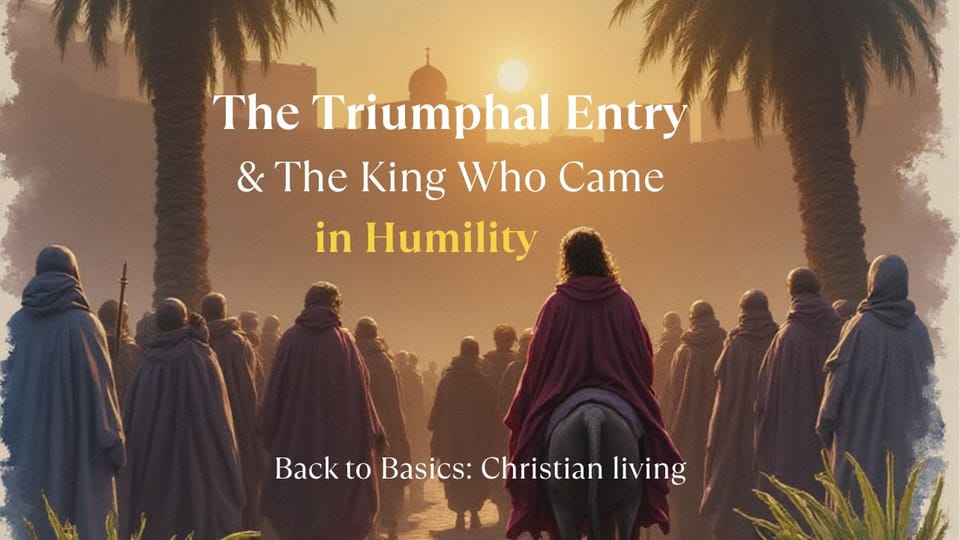
Have you ever witnessed a moment so significant that it seemed to hang in the air, suspended between expectation and reality? That's precisely what happened on the dusty roads leading into Jerusalem over two thousand years ago. The Triumphal Entry wasn't just another day in the life of Jesus—it was the fulfilment of ancient prophecy, a divine appointment where heaven's King rode into the earthly city, not on a warhorse, but on a humble donkey.
The Prophetic Promise
Centuries before that momentous day, the prophet Zechariah had penned words that would echo through time: "Rejoice greatly, O daughter of Zion; shout, O daughter of Jerusalem: behold, thy King cometh unto thee: he is just, and having salvation; lowly, and riding upon an ass, and upon a colt the foal of an ass" (Zechariah 9:9, KJV). This wasn't a casual observation—it was a divine blueprint, a promise waiting for its appointed hour.
When Jesus sent His disciples to fetch that colt, He wasn't simply arranging transport. He was orchestrating the fulfilment of Scripture with meticulous precision. "And they brought the colt to Jesus, and cast their garments on him; and he sat upon him" (Mark 11:7, KJV). Every detail mattered. This wasn't the mount of a conquering general—Roman triumphators rode stallions. This was the ride of a different kind of King altogether.
The Paradox of Power
Here's where things get beautifully paradoxical. In the ancient world, kings and conquerors made their grand entrances on mighty warhorses, surrounded by armed guards, with captives in chains trailing behind them. They came in displays of raw power designed to intimidate and impress. But not Jesus. He came riding on a donkey—the transport of the common person, the beast of burden for the everyday traveller.
This wasn't weakness; it was a radical redefinition of power itself. Jesus was demonstrating that true authority doesn't need to swagger or shout. It doesn't need military might or political posturing. The King of Kings chose humility as His banner, and in doing so, He turned the world's understanding of power completely upside down.
Matthew's Gospel captures the prophetic significance beautifully: "All this was done, that it might be fulfilled which was spoken by the prophet, saying, Tell ye the daughter of Sion, Behold, thy King cometh unto thee, meek, and sitting upon an ass, and a colt the foal of an ass" (Matthew 21:4-5, KJV).
Hosanna in the Highest
Now, let's talk about the crowd's response. The people went absolutely wild. They spread their cloaks on the road, cut down branches from the trees, and created an impromptu red carpet for their King. But it's their cry that truly matters: "Hosanna!"
"And they that went before, and they that followed, cried, saying, Hosanna; Blessed is he that cometh in the name of the Lord" (Mark 11:9, KJV). "Hosanna" literally means "save now" or "save, we pray." It was both a cry for deliverance and an expression of praise. The crowd was proclaiming Jesus as their deliverer, their promised Messiah.
John's account adds another layer: "Took branches of palm trees, and went forth to meet him, and cried, Hosanna: Blessed is the King of Israel that cometh in the name of the Lord" (John 12:13, KJV). They were quoting Psalm 118, a messianic psalm sung during Passover. The people recognised—at least in that moment—that prophecy was being fulfilled before their very eyes.
The Tears Behind the Triumph
But here's what makes this story even more profound. Luke gives us a detail that the other Gospel writers don't include. As Jesus approached Jerusalem and saw the city spread out before Him, He wept. "And when he was come near, he beheld the city, and wept over it, saying, If thou hadst known, even thou, at least in this thy day, the things which belong unto thy peace! but now they are hid from thine eyes" (Luke 19:41-42, KJV).
Imagine that. In the midst of triumph, tears. Whilst the crowds shouted "Hosanna," Jesus mourned. He knew what they didn't—that many of these same voices would soon be shouting "Crucify Him!" He knew that Jerusalem would reject its Messiah, and the consequences would be devastating. His humility extended even to this: He came knowing He would be rejected, yet He came anyway.
What This Means for Us
So what do we do with all this? The Triumphal Entry isn't just a nice story from ancient history—it's a living challenge to how we understand power, success, and kingship today.
First, it reminds us that God's ways are not our ways. Whilst we chase after status and recognition, Christ comes in humility. Whilst we measure success by worldly standards, Christ defines it through service and sacrifice. The King who rode a donkey is the same King who washed His disciples' feet and died on a criminal's cross.
Second, it challenges us about the kind of Saviour we want. The crowds wanted a political deliverer who would overthrow Rome. They wanted earthly power restored to Israel. But Jesus came to deal with a far deeper problem—the sin that enslaves every human heart. He came to establish a kingdom not of this world, one that operates on principles of love, sacrifice, and redemption.
Third, it calls us to examine our own "Hosannas." Are we ready to follow a King who calls us to humility? Are we prepared to worship a Saviour who demands not just our praise on Sunday, but our lives every day? The crowd's enthusiasm was real, but for many, it was short-lived. When Jesus didn't meet their expectations, their "Hosannas" turned to hatred.
The King Is Here
The beautiful truth of the Triumphal Entry is this: the King came. He came exactly as promised, exactly when promised, exactly how promised. Zechariah's prophecy found its fulfilment in Jesus. Every detail mattered because every detail was ordained.
And He's still coming—not now on a donkey, but one day returning in glory. "Behold, he cometh with clouds; and every eye shall see him" (Revelation 1:7, KJV). The King who came in humility will return in majesty. The Saviour who wept over Jerusalem will wipe away every tear. The One who rode to His death will reign in eternal life.
Until that day, we're called to live as citizens of His upside-down kingdom—where the last are first, the humble are exalted, and the greatest is the servant of all. We're called to echo the crowd's cry, not just with our lips but with our lives: "Hosanna! Save now! Blessed is He that comes in the name of the Lord!"
The King has come. The King is here. The King is coming again. The question is: will we recognise Him when He does?
Key Takeaways
- Jesus deliberately fulfilled prophecy. The Triumphal Entry was not accidental. It was a precise fulfilment of Zechariah 9:9 KJV, showing Jesus as the promised King and Messiah.
- Jesus redefined what “power” looks like. He entered Jerusalem on a donkey, not a warhorse, showing that the kingdom of God advances through humility, not intimidation or spectacle.
- “Hosanna” is both praise and a plea. The crowd’s cry (“save now”) reveals both their worship and their deep need for deliverance, even if many misunderstood what kind of salvation Jesus came to bring.
- Public enthusiasm is not the same as true discipleship. The same crowd that celebrated could later reject. The blog challenges readers to examine whether faith is steady or only present when expectations are met.
- Jesus carried compassion even in triumph. Jesus wept over Jerusalem (Luke 19:41–42 KJV), showing a heart that grieves over spiritual blindness and coming judgement, even while being praised.
- The real rescue was deeper than politics. The people wanted liberation from Rome, but Jesus came to deal with sin and establish a kingdom “not of this world,” rooted in redemption and sacrifice.
- The Triumphal Entry calls for personal response. It asks whether we will follow a King who calls us to humility and obedience, not just moments of emotional praise.
- There is a future return that completes the story. The King who came in humility will come again in glory (Revelation 1:7 KJV). The blog points readers to live ready, as citizens of that “upside-down” kingdom.