The Unknown Road!
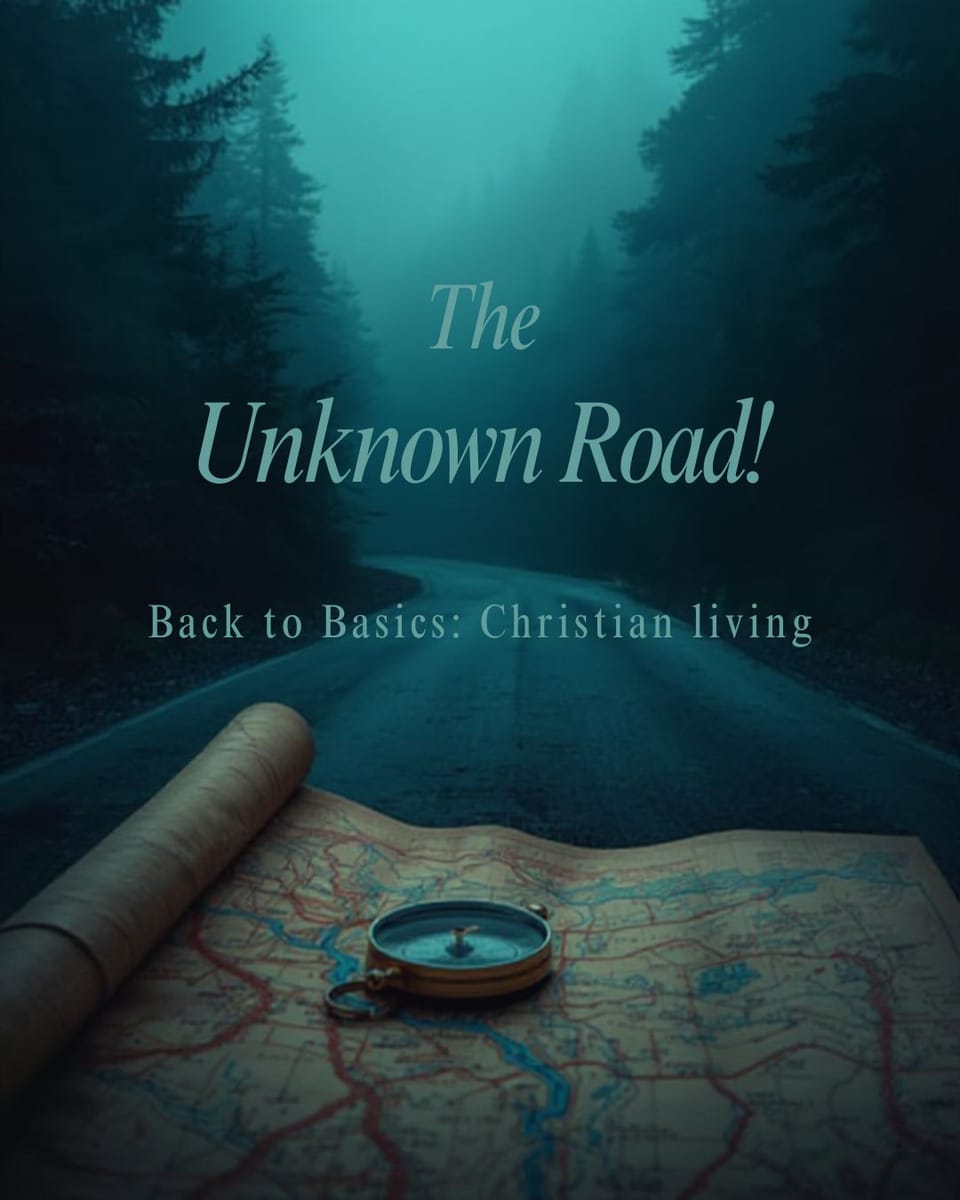
Trusting the Guide, Not the Map
Standing at life's crossroads can be both exhilarating and terrifying. As Christians, we frequently find ourselves gazing down unfamiliar paths—careers we've never pursued, relationships that challenge us, health battles we didn't expect, or callings that seem to defy logic. The unknown road stretches before us, and we're left wondering: How do I move forward when I can't see what's ahead?
This tension between faith and sight isn't new. Throughout Scripture, God's people have walked roads they couldn't map, trusting a Guide they couldn't always see. As Paul wrote, "For we walk by faith, not by sight" (2 Corinthians 5:7, KJV). The unknown road isn't an obstacle to faith—it's the very terrain where authentic faith flourishes.
The Nature of the Unknown Road
What makes a road "unknown"? It's not merely unfamiliarity, though that's part of it. The unknown road represents any journey where outcomes aren't guaranteed, where our human wisdom falls short, where control slips through our fingers like sand. It might be a redundancy notice that arrives without warning, a medical diagnosis that changes everything, a relational rupture we didn't see coming, or a divine calling that seems to contradict everything we've built.
These moments expose our deepest anxieties. We're creatures who crave certainty, who build elaborate plans and contingencies. Yet God reminds us, "For my thoughts are not your thoughts, neither are your ways my ways, saith the LORD. For as the heavens are higher than the earth, so are my ways higher than your ways, and my thoughts than your thoughts" (Isaiah 55:8-9, KJV). God often leads us precisely where our plans can't reach—not to torment us, but to teach us something profoundly liberating: we were never meant to navigate life's roads alone.
Proverbs 3:5-6 (KJV) captures this beautifully: "Trust in the LORD with all thine heart; and lean not unto thine own understanding. In all thy ways acknowledge him, and he shall direct thy paths". The instruction isn't to understand before trusting, but to trust instead of leaning on understanding. The unknown road becomes the place where this truth moves from theory to reality.
Biblical Examples of Unknown Roads
Consider the Israelites trapped between the Red Sea and Pharaoh's advancing army. They stood at what appeared to be a dead end—water ahead, enemies behind, death seemingly inevitable. This was the ultimate unknown road: no escape route, no human solution, no precedent for what to do next.
Yet Moses declared, "Fear ye not, stand still, and see the salvation of the LORD, which he will shew to you to day: for the Egyptians whom ye have seen to day, ye shall see them again no more for ever. The LORD shall fight for you, and ye shall hold your peace" (Exodus 14:13-14, KJV). What followed defied every natural law—a road through the sea itself. "And the children of Israel went into the midst of the sea upon the dry ground: and the waters were a wall unto them on their right hand, and on their left" (Exodus 14:22, KJV). God didn't just provide a way; He transformed the impossible barrier into the path of deliverance. Sometimes the unknown road doesn't go around our obstacles but straight through them.
Abraham's journey offers perhaps the most striking example. Hebrews 11:8 (KJV) tells us: "By faith Abraham, when he was called to go out into a place which he should after receive for an inheritance, obeyed; and he went out, not knowing whither he went". No satellite navigation, no travel guides, no detailed itinerary—just God's voice and Abraham's willingness to follow it into uncertainty. Later, God tested Abraham's faith even further, commanding him to sacrifice his son Isaac. "And Abraham said, My son, God will provide himself a lamb for a burnt offering" (Genesis 22:8, KJV). Even on this most difficult unknown road, Abraham trusted God's provision.
This wasn't recklessness; it was faith. Abraham didn't need to know the destination because he knew the Guide. His story reminds us that the unknown road isn't about having all the answers—it's about knowing the One who does.
The Apostle Paul also embraced the unknown road: "And now, behold, I go bound in the spirit unto Jerusalem, not knowing the things that shall befall me there: Save that the Holy Ghost witnesseth in every city, saying that bonds and afflictions abide me" (Acts 20:22-23, KJV). Paul didn't have clarity about outcomes, yet he moved forward with conviction, declaring, "But none of these things move me, neither count I my life dear unto myself, so that I might finish my course with joy, and the ministry, which I have received of the Lord Jesus, to testify the gospel of the grace of God" (Acts 20:24, KJV). His uncertainty didn't paralyse him; rather, it deepened his dependence on God's guidance and strengthened his resolve to complete his calling.
Why God Leads Us Down Unknown Roads
Why doesn't God simply illuminate the entire journey from the start? Isaiah 42:16 (KJV) provides insight: "And I will bring the blind by a way that they knew not; I will lead them in paths that they have not known: I will make darkness light before them, and crooked things straight. These things will I do unto them, and not forsake them".
Notice what God promises: He will lead, He will illuminate, He will straighten what's crooked, and He will not forsake. But He does this progressively, not all at once. This isn't divine withholding—it's divine wisdom. If we could see the entire journey, we might trust the map rather than the Mapmaker. We might rely on the plan rather than the Planner.
The unknown road strips away our illusions of self-sufficiency. It reminds us of Jesus's words: "I am the vine, ye are the branches: He that abideth in me, and I in him, the same bringeth forth much fruit: for without me ye can do nothing" (John 15:5, KJV). We're not meant to be autonomous, independent beings charting our own course. We're designed for dependence—not the unhealthy kind that cripples, but the sacred kind that liberates. When we can't see ahead, we're forced to look up.
Navigating the Unknown Road: Biblical Principles
How, then, do we walk these unfamiliar paths? Scripture offers several essential principles:
Follow God's light one step at a time
"Thy word is a lamp unto my feet, and a light unto my path" (Psalm 119:105, KJV). Notice the lamp isn't a floodlight illuminating miles ahead—it's a lamp for your feet, lighting the immediate step before you. God's Word provides enough light for the next decision, the next conversation, the next day. As the psalmist declares, "The entrance of thy words giveth light; it giveth understanding unto the simple" (Psalm 119:130, KJV). Trust that light, even when you can't see beyond it.
Remember God's faithfulness in past journeys
The psalmist prays, "Hide not thy face far from me; put not thy servant away in anger: thou hast been my help; leave me not, neither forsake me, O God of my salvation" (Psalm 27:9, KJV). Look back at the unknown roads you've already travelled. Remember how God met you there, how provision appeared, how strength came when needed. "Bless the LORD, O my soul, and forget not all his benefits" (Psalm 103:2, KJV). Past faithfulness is the foundation for present trust.
Embrace divine companionship on the journey
Jesus promised, "Teaching them to observe all things whatsoever I have commanded you: and, lo, I am with you alway, even unto the end of the world" (Matthew 28:20, KJV). The unknown road isn't a solitary journey. God walks with you, His presence accompanying every uncertain step. "When thou passest through the waters, I will be with thee; and through the rivers, they shall not overflow thee: when thou walkest through the fire, thou shalt not be burned; neither shall the flame kindle upon thee" (Isaiah 43:2, KJV). You're never alone on this path, no matter how isolated you might feel.
The Adventure of Faith
Perhaps we need to reframe how we think about the unknown road. Instead of viewing it as something to fear or avoid, what if we saw it as an invitation to adventure? Not the reckless kind that ignores wisdom, but the sacred kind that embraces mystery whilst trusting in God's character. "But without faith it is impossible to please him: for he that cometh to God must believe that he is, and that he is a rewarder of them that diligently seek him" (Hebrews 11:6, KJV).
The unknown road is where we discover that God is more faithful than we imagined, more present than we realised, more capable than we believed. "Now unto him that is able to do exceeding abundantly above all that we ask or think, according to the power that worketh in us" (Ephesians 3:20, KJV). It's where faith stops being theoretical and becomes experiential. It's where we learn that trust isn't the absence of fear but the decision to move forward despite it, knowing "The LORD is my light and my salvation; whom shall I fear? the LORD is the strength of my life; of whom shall I be afraid?" (Psalm 27:1, KJV).
As you stand at your own crossroads, gazing down whatever unknown road lies before you, remember this: the road may be unfamiliar, but the Guide is not. "The steps of a good man are ordered by the LORD: and he delighteth in his way" (Psalm 37:23, KJV). He's walked every path before you, preparing the way and promising to direct your steps. The unknown road need not be feared when you know the One who walks beside you.
May you embrace the journey ahead with courage and confidence, trusting that even when you cannot see around the bend, you can trust the One who has already gone before you—and who will never leave you behind. "Be strong and of a good courage, fear not, nor be afraid of them: for the LORD thy God, he it is that doth go with thee; he will not fail thee, nor forsake thee" (Deuteronomy 31:6, KJV).
Key Takeaways:
- The unknown road is where faith becomes real: Trust isn't about understanding everything beforehand—it's about following God despite uncertainty.
- God's light illuminates one step at a time: Scripture provides enough guidance for the immediate decision, not the entire journey. Trust each step as it's revealed.
- Biblical heroes embraced uncertainty: Abraham went "not knowing whither he went," the Israelites walked through the Red Sea, and Paul moved forwards despite knowing afflictions awaited—all trusting God's faithfulness.
- Unknown roads deepen dependence on God: When we can't see ahead, we're forced to look up, shifting from self-reliance to sacred dependence on our Guide.
- God never forsakes us on the journey: His promise of presence accompanies every uncertain step—we're never alone, even when the path feels isolating.
- Past faithfulness builds present trust: Remembering how God met you on previous unknown roads strengthens courage for the current journey.
- The unknown road is an invitation to adventure: Rather than fearing uncertainty, embrace it as an opportunity to discover God's exceeding faithfulness and capability.