Why So Many Denominations? Understanding the Splintered Church!
The Path Forward: Practical Steps Towards Unity
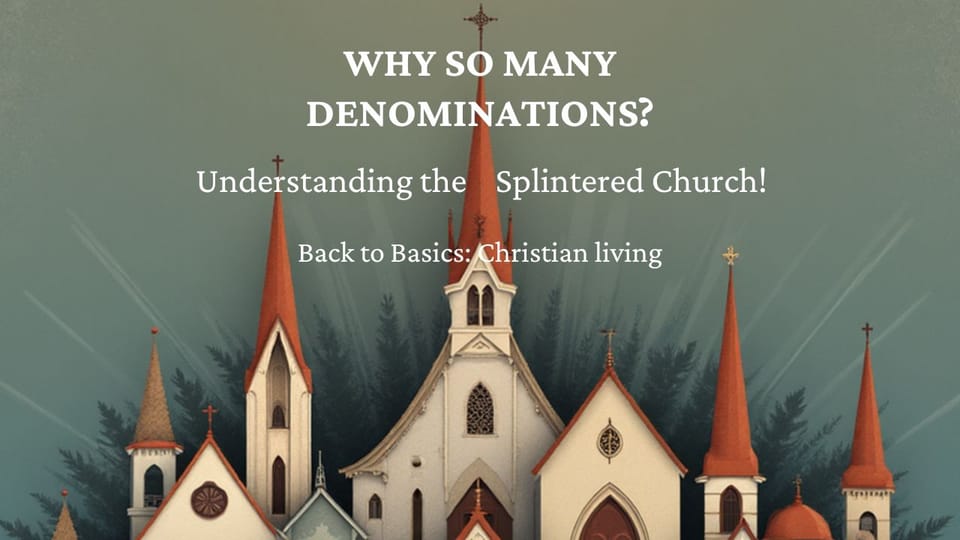
The Christian faith, which should unite believers under one Head—Jesus Christ—has instead become fragmented into thousands of denominations, each claiming to possess the correct interpretation of Scripture. This splintered reality causes genuine seekers to question the validity of Christianity itself. If the church is truly Christ's body, why does it appear so divided? Let us explore this troubling question through the lens of Scripture.
The Original Design: One Body, One Spirit
The Apostle Paul wrote clearly about the intended unity of the church: "There is one body, and one Spirit, even as ye are called in one hope of your calling; One Lord, one faith, one baptism, One God and Father of all, who is above all, and through all, and in you all" (Ephesians 4:4-6, KJV). This passage emphasises the singular nature of the faith—one body, one Spirit, one hope, one Lord, one faith, one baptism, one God. There is no room here for multiple competing versions of truth.
Paul further instructed the Corinthian church: "Now I beseech you, brethren, by the name of our Lord Jesus Christ, that ye all speak the same thing, and that there be no divisions among you; but that ye be perfectly joined together in the same mind and in the same judgment" (1 Corinthians 1:10, KJV). The early church was meant to be unified in doctrine, purpose, and mission.
The Warning Against Division
Scripture repeatedly warns against the very divisions we see today. Paul addressed this directly: "For ye are yet carnal: for whereas there is among you envying, and strife, and divisions, are ye not carnal, and walk as men?" (1 Corinthians 3:3, KJV). Denominational pride and doctrinal territorialism are marks of carnality, not spiritual maturity.
Jesus Himself prayed for unity amongst His followers: "Neither pray I for these alone, but for them also which shall believe on me through their word; That they all may be one; as thou, Father, art in me, and I in thee, that they also may be one in us: that the world may believe that thou hast sent me" (John 17:20-21, KJV). Notice the purpose of this unity—so that the world would believe. Our divisions hinder the very mission Christ gave us.
How Did We Get Here?
The splintering of the church didn't happen overnight. It began subtly, as Paul warned: "For I know this, that after my departing shall grievous wolves enter in among you, not sparing the flock. Also of your own selves shall men arise, speaking perverse things, to draw away disciples after them" (Acts 20:29-30, KJV). False teachers, personal ambition, and doctrinal innovation created fractures in what should have been a unified body.
Human pride plays a significant role. We read in Proverbs: "Only by pride cometh contention: but with the well advised is wisdom" (Proverbs 13:10, KJV). Many denominations exist not because of genuine doctrinal necessity, but because leaders refused to submit to one another in humility, preferring to establish their own interpretation as supreme.
The Core vs. The Periphery
Whilst unity is essential, we must distinguish between core doctrines and secondary matters. The core includes Christ, salvation by grace through faith, the authority of Scripture, the resurrection. Paul wrote: "But though we, or an angel from heaven, preach any other gospel unto you than that which we have preached unto you, let him be accursed" (Galatians 1:8, KJV). The gospel itself is non-negotiable.
However, secondary issues—modes of worship, church governance structures, or interpretations of prophecy—should not divide the body of Christ. Paul addressed such matters: "Him that is weak in the faith receive ye, but not to doubtful disputations" (Romans 14:1, KJV). Believers should extend grace on peripheral matters whilst standing firm on foundational truth.
The Impact on Seekers
When unbelievers observe Christians arguing over doctrine, forming separate camps, and claiming exclusive truth, they understandably question whether any of it is real. Jesus said, "By this shall all men know that ye are my disciples, if ye have love one to another" (John 13:35, KJV). Instead of love, the watching world often sees competition and condemnation.
This confusion can lead to unbelief. When a seeker encounters Baptists contradicting Pentecostals, who contradict Presbyterians, who contradict Catholics, they may conclude that no one truly knows the truth—or worse, that there is no truth to know.
A Call to Biblical Unity
So what is the solution? We must return to the authority of Scripture alone. "All scripture is given by inspiration of God, and is profitable for doctrine, for reproof, for correction, for instruction in righteousness: That the man of God may be perfect, throughly furnished unto all good works" (2 Timothy 3:16-17, KJV). When we elevate tradition, personal preference, or denominational loyalty above God's Word, we create the very divisions Christ prayed against.
We must also humble ourselves. "Let nothing be done through strife or vainglory; but in lowliness of mind let each esteem other better than themselves" (Philippians 2:3, KJV). Unity requires that we submit our own interpretations to scrutiny and be willing to admit when we are wrong.
Furthermore, we must focus on the essentials. Paul wrote: "For other foundation can no man lay than that is laid, which is Jesus Christ" (1 Corinthians 3:11, KJV). Christ, not our denominational distinctives, must be our foundation.
Hope for the Future
Despite the current fragmentation, Scripture promises that Christ will ultimately present His church unified and perfected: "That he might present it to himself a glorious church, not having spot, or wrinkle, or any such thing; but that it should be holy and without blemish" (Ephesians 5:27, KJV). The unity we fail to achieve through human effort, Christ will accomplish through His work.
Until that day, we must pursue unity where possible, stand firm on essential doctrine, extend grace on secondary matters, and above all, point people to Christ rather than to our denominations. "Endeavouring to keep the unity of the Spirit in the bond of peace" (Ephesians 4:3, KJV) must be our constant aim.
The splintered state of the church is both a scandal and a tragedy, hindering the gospel and confusing seekers. Yet it need not lead to unbelief. The problem is not with God or His Word, but with our failure to submit fully to both. When we humble ourselves, prioritise Scripture above tradition, and focus on Christ rather than our differences, we take steps towards the unity for which our Saviour prayed. The true body of Christ exists across denominational lines—it includes all who genuinely trust in Jesus Christ for salvation. Our challenge is to recognise this reality and live accordingly…
Key Takeaways:
- Unity is God's design for the church: Scripture teaches there is one body, one Spirit, one Lord, one faith—denominational division contradicts this divine blueprint.
- Division harms the gospel witness: Jesus prayed for unity specifically so the world would believe; our fractures push seekers away from Christ.
- Pride and human ambition fuel denominationalism: Many splits arise not from doctrinal necessity but from unwillingness to submit humbly to one another.
- Distinguish core doctrine from secondary matters: Stand firm on essentials like Christ, salvation by grace, and Scripture's authority—extend grace on peripheral issues.
- Scripture alone must be our authority: Elevating tradition or denominational loyalty above God's Word creates the very divisions Christ prayed against.
- The true church transcends denominations: Christ's body includes all genuine believers across human-made lines—we must recognise and live this reality.
- Humility is essential for unity: We must submit our interpretations to scrutiny and esteem others above ourselves in lowliness of mind.
- Christ will ultimately perfect His church: Though we fail now, Scripture promises Jesus will present His church unified, holy, and without blemish.