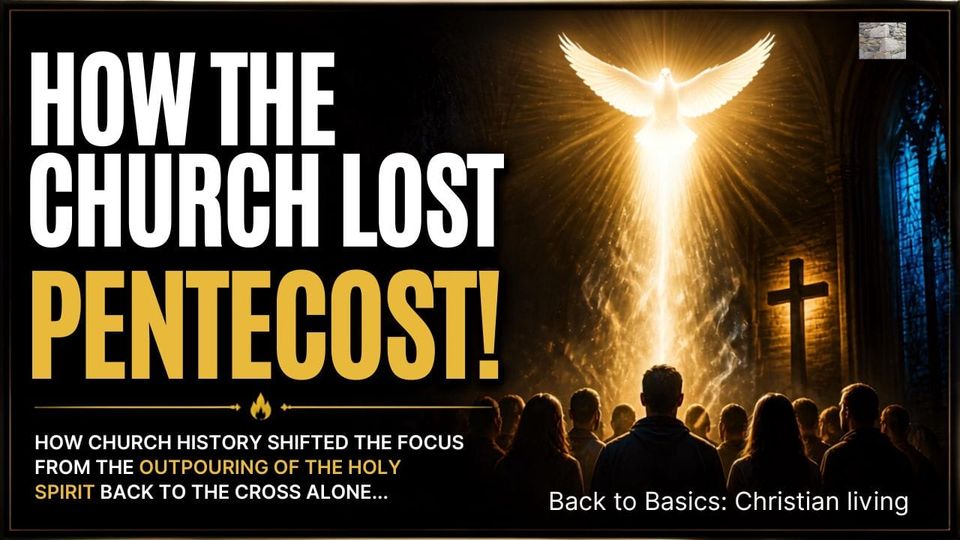
How the Church Lost Pentecost!
Where the Early Church Began
If you read the book of Acts with fresh eyes, something stands out very quickly.
The early believers preached Christ crucified, but they did not stop there. They preached Christ risen. They preached Christ ascended. And they preached the Holy Spirit poured out.
Peter stood up on the day of Pentecost and told the crowd plainly, "This Jesus hath God raised up, whereof we all are witnesses. Therefore being by the right hand of God exalted, and having received of the Father the promise of the Holy Ghost, he hath shed forth this, which ye now see and hear" [Acts 2:32-33 KJV].
Notice the order in that message. The cross, then the resurrection, then the exaltation, then the outpouring.
The first church did not treat Pentecost as an add-on. It was the evidence that Jesus Christ had been raised and exalted and that God our Father had opened the way back to Himself through His Son. It was not a strange spiritual bonus for a special group of believers. It was the promise of the Father, given to the body of Christ.
That is where the church began.
So how did we get to a place where much of Christianity now speaks almost entirely about the cross, and very little about the Holy Spirit?
That did not happen overnight. It happened slowly, through history, through pressure, through reaction, and through the way men organised religion.
When the Church Became an Institution
In the early years, believers gathered in homes, taught the Word, prayed together, and lived out a faith that cost them something. The life of God among them was obvious.
But as time went on, the church became increasingly organised, and eventually became an institution with power, position, and property.
That changed things.
When a church becomes an institution, it needs control. It needs order. It needs structure it can manage. And the working of the Holy Spirit is not something men can control. So, over time, the emphasis moved away from the living working of God among ordinary believers and towards ceremony, hierarchy, and religious ritual.
The Lord's death became something to be re-enacted rather than a finished work to be rested in and lived from. Ministry became a profession rather than a service. The believer became a spectator rather than a member of the body.
And once the believer became a spectator, the Holy Spirit was pushed to the edges of church life.
Not denied outright, but quietly side lined.
That is often how error works. It rarely announces itself. It simply moves the emphasis.
The Reformation and Its Emphasis
Then came the Reformation, and we should thank God for much of it.
Men stood up and said that salvation is by grace through faith, not by works, not by ceremony, not by the machinery of religion. They put the Bible back into the hands of ordinary people. They preached justification. They preached the blood of Christ. They preached the cross.
That was needed.
But every reaction carries a risk. When you fight one error, you can drift into another emphasis and leave something else behind.
The Reformers were fighting a religious system built on works, ritual, and human authority. So the great battleground became the cross, the blood, and justification by faith.
And so, in much of Protestant Christianity, the cross became the centre of the message. The finished work of Christ was declared clearly. That is a mercy.
But the outpouring of the Holy Spirit, and the practical living of the Christian life in the power of God, received far less attention.
Once again, the emphasis shifted.
The message became: "Christ died for you, believe and be saved." That is true. But it can quietly leave out what God did next.
From Living Faith to Doctrinal Position
As centuries passed, Christianity in many places became a matter of correct belief rather than daily walk.
People learned to say the right things about the cross while knowing very little of the daily working of God in their lives.
That is a serious loss.
The Bible does not present the Christian life as a doctrinal position we hold. It presents it as a walk we live. And that walk is not lived by human effort.
The Bible says, "This I say then, Walk in the Spirit, and ye shall not fulfil the lust of the flesh" [Galatians 5:16 KJV].
That is practical. That is daily. That is real.
But if a believer is taught that Christianity is mainly about being forgiven, and hears very little about the Holy Spirit given to them, what happens? They will try to live the Christian life in their own strength. They will fight sin with willpower. They will serve God out of duty. They will feel guilty when they fail, and they will get tired.
And a tired, guilty Christian often ends up focusing even more on the cross alone, because that is where forgiveness is found, and forgiveness is what they keep needing.
Do you see the cycle?
Not because the cross is wrong to preach, but because the rest of what God has done is barely mentioned.
Fear, Reaction, and Extremes
There is another reason the Holy Spirit slipped from the centre of teaching in many churches.
Fear.
Over the years, some who claimed the working of the Spirit brought in confusion, disorder, sensationalism, and things that could not be supported by Scripture. Excess in one direction always produces suspicion in the other.
So many godly believers, wanting to protect the truth, quietly stepped back. Rather than teach the Holy Spirit plainly from Scripture, they said little. Better to be safe. Better to keep to the cross, forgiveness, and good conduct.
But the answer to error has never been silence. The answer to error is sound teaching from the Word of God.
If something is being abused, we do not abandon it. We go back to the Bible and get it right.
The Lord Jesus said, "But the Comforter, which is the Holy Ghost, whom the Father will send in my name, he shall teach you all things" [John 14:26 KJV].
That was not given to cause confusion. It was given to help God's people.
What We Have Lost by Stopping Short
When Pentecost is pushed aside, several things quietly disappear from Christian living.
We lose the sense of God's nearness. We start thinking of God as far off, and ourselves as merely pardoned criminals hoping to behave until the end.
We lose power for daily obedience. Christianity becomes a set of rules to keep rather than a life to walk.
We lose boldness in witness. The early believers were not naturally brave. They received something.
We lose the reality of being reconciled to God. Because reconciliation is not only about our sins being dealt with. It is about being brought back to God Himself.
The Bible says, "For through him we both have access by one Spirit unto the Father" [Ephesians 2:18 KJV].
Access to the Father. That is what was lost in Eden. That is what Christ restored.
The cross removed what kept us out. The resurrection and ascension declared Christ as Lord. The outpouring of the Holy Spirit brought God's presence and power into the daily life of the believer.
If we stop at the cross, we thank God for the door and never walk through it.
Coming Back to the Whole Message
So what do we do?
We do not swing to another extreme. We do not build a Christianity around experience, feelings, or spectacle. That is just another ditch on the other side of the road.
We go back to the Bible and let it set the emphasis.
Christ died for our sins. Christ rose again. Christ ascended and is Lord. The Holy Spirit has been given. And in Christ, we are reconciled to God.
That is the whole message, and God's people need all of it.
The cross is not in competition with Pentecost. Pentecost is the fruit of the finished work of Christ. One does not diminish the other.
Church history moved the emphasis. Scripture must move it back.
A Clear Step of Obedience
Here is the practical step.
Stop living as though your Christianity ends at forgiveness.
This week, take one area where you have been trying to live the Christian life in your own strength, and bring it honestly to God. Say plainly: "Lord, I have been trying to do this on my own."
Then open the Word, pray, and start walking in dependence on God rather than determination alone.
Thank God for the cross every day. Never move away from it.
But do not stop there.
Christ died. Christ rose. Christ ascended. The Holy Spirit was poured out. And through Jesus Christ, you have been brought back to God.
So walk worthy of the Lord unto all pleasing, being fruitful in every good work…
Key Takeaways:
- The early church preached the cross, the resurrection, the ascension, and the outpouring of the Holy Spirit together — [Acts 2:32-33 KJV]
- The Christian life is a daily walk in the Spirit, not merely a doctrinal position — [Galatians 5:16 KJV]
- The Holy Spirit was given to teach and help God's people, not to cause confusion — [John 14:26 KJV]
- Through Christ, we have access to the Father — [Ephesians 2:18 KJV]
- The answer to error is never silence; it is sound teaching from the Word of God — [2 Timothy 3:16 KJV]
Find us everywhere — 🌐 Blog: https://back-to-basics-christian-living.ghost.io/ ▶️ YouTube: https://www.youtube.com/@backtobasicschristianliving 📱 Socials: https://linktr.ee/backtobasicschristianliving