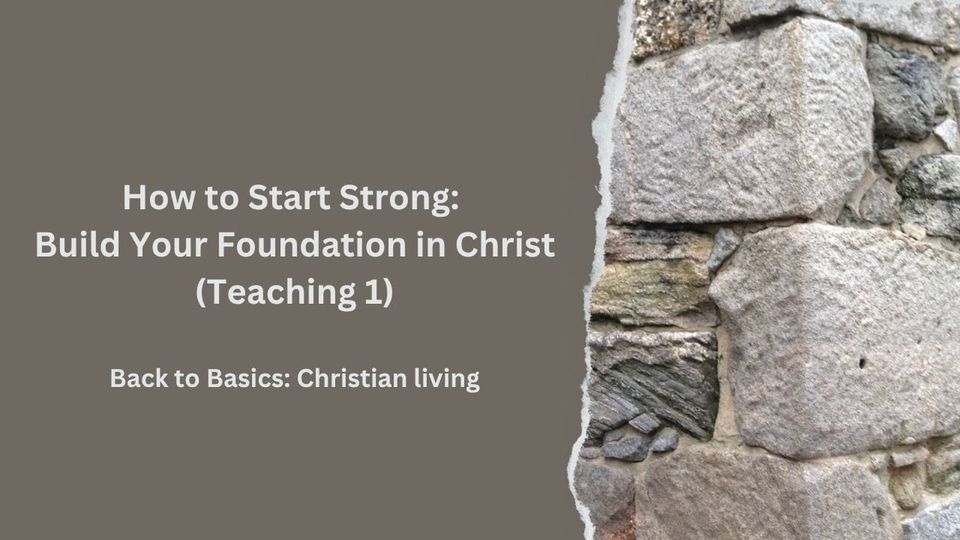
How to Start Strong: Build Your Foundation in Christ (Teaching 1)
Why the first step matters
If you’re joining me for this “How to” series, I want to start with something very simple—but absolutely vital: the goal here isn’t to give you more Christian information. It’s to help you build a life that stands up when the rain comes.
A lot of believers don’t drift because they suddenly decide they don’t believe anymore. They drift because they tried to build peace, confidence, and victory on top of a weak foundation. And sooner or later, life exposes what we’re really built on.
The Bible says it plainly: “For other foundation can no man lay than that is laid, which is Jesus Christ” (1 Corinthians 3:11 KJV). So this first teaching is about starting the right way—by laying the right foundation.
Foundation isn’t feelings—it’s the Word
We live in a culture that trains us to follow feelings. If we feel close to God, we think we’re doing well. If we feel dry, we assume something’s wrong. But a strong Christian life can’t be built on moods—it has to be built on truth.
Jesus spoke about two houses. Both houses faced storms. One stood, one fell. The difference wasn’t the weather—it was the foundation. “And it fell not: for it was founded upon a rock” (Matthew 7:25 KJV).
So here’s the question I want you to sit with: are you building your Christian life on Scripture, or on a version of Christianity you’ve picked up from culture, tradition, or even personal preference?
Start where God starts: who Jesus is—and who you are in Him
Before we talk about prayer, Bible study, the Spirit, spiritual gifts, or warfare, we have to settle this: Jesus Christ is Lord. He is King. And being a Christian is not self-improvement—it’s new life.
The Word of God says, “Therefore if any man be in Christ, he is a new creature: old things are passed away; behold, all things are become new” (2 Corinthians 5:17 KJV).
So your first step is not “try harder.” Your first step is to believe what God says is already true in Christ, and to begin aligning your life with it.
Here’s something practical you can do today: take a notebook (or your phone notes) and write one simple sentence at the top—“In Christ, God has started something new in me.” Then underneath it, write a few honest areas where you want to see real change. Not religious words—real life. And pray in plain language: “Lord, I agree with Your Word. Teach me who I am in Christ, and help me walk it out.”
Make repentance normal (not dramatic)
One of the quickest ways to grow is to stop treating repentance like an emergency button and start treating it like a healthy, normal part of discipleship.
Jesus preached it from the beginning: “Repent: for the kingdom of heaven is at hand” (Matthew 4:17 KJV).
Repentance isn’t shame. It’s agreement with God. It’s the moment you stop defending what God is correcting. When the Lord puts a finger on something—an attitude, a compromise, bitterness, hidden sin—the answer isn’t to explain it away. The answer is to surrender it.
Try this for the next week: at some point each day, take two minutes and ask, “Lord, is there anything I’m excusing that You’re calling sin?” If He brings something to mind, confess it plainly. Thank Him for forgiveness. And then take one small step that same day to move in the right direction. That’s not condemnation—that’s growth.
From information to transformation
It’s possible to hear teaching, read verses, and still stay stuck. So from day one in this series, I want you to understand the difference between knowing and doing.
This isn’t a spectator series. It’s an obedience series. Jesus didn’t call us to admire the Word—He called us to live it.
So keep it simple: choose a short passage in the Gospels, read it slowly, and ask, “What does this show me about Jesus?” and “What is this calling me to obey?” Then obey one thing immediately—even if it’s small. Small obedience, done consistently, builds spiritual strength.
A simple daily rhythm (Word + prayer + obedience)
You don’t need a complicated routine to start strong. You need a steady one.
If you can give the Lord 10–15 minutes a day, consistently, you can build a foundation that lasts. Read a small portion of Scripture, talk to the Lord about what you’ve read, and write down one step you will take that day in response. Keep it honest, keep it simple, keep it steady.
Don’t do this alone: connect to the Body
A strong foundation isn’t just “me and my Bible.” God places believers into a Body.
“So we, being many, are one body in Christ, and every one members one of another” (Romans 12:5 KJV).
If you’re not connected to a Bible-believing church, make that a priority. And if you are, ask yourself honestly: are you truly planted, or just attending? God uses fellowship, encouragement, correction, and accountability to strengthen us.
Closing encouragement
If you’ve been trying to live a strong Christian life without a strong foundation, don’t be discouraged—just start again, the right way.
This series is here to help you do that. One teaching at a time. One step at a time. One act of obedience at a time.
Next time, we’ll get practical about the Word: how to read it, understand it, and apply it without turning it into mere information…
Key Takeaways:
- Build on the right foundation: Jesus Christ, not emotions or opinions (1 Corinthians 3:11 KJV)
- Storms reveal foundations, so choose Scripture as the “rock” you build on (Matthew 7:25 KJV)
- Christian growth starts with identity: new life in Christ, not self-improvement (2 Corinthians 5:17 KJV)
- Make repentance a normal daily practice: agree with God and turn quickly (Matthew 4:17 KJV)
- Move from information to transformation: obey what you read, starting small and consistent
- Keep a simple daily rhythm: Word, prayer, and one step of obedience
- Strengthen your foundation through connection to the Body and being truly planted (Romans 12:5 KJV)